The engineer is concerned primarily with mechanical behaviour, water absorption and permeability, and durability. All these properties are controlled in some measure by the porous nature of brick ceramic.
Microstructure of brick
The pore structures of 3 clay bricks as revealed at fracture surfaces under high magnification.
The individual particles of the unfired clay have been transformed into an apparently uniform ceramic matrix, throught which there runs a continuous network of voids.
 |
(a) pressed fletton common water (absorption WA 17 %) (b) wirecut (WA 7.5 %) (c) pressed engineering class A (WA 4 %). The length of scale bar is 5 µm. |
The volume fraction porosity of commercially available clay bricks varies greatly, from about 1 % to at least 50 %. The porosity depends both on clay composition and on the duration and temperature of firing. The pores have dimensions typically about 1 to 10 µm. There appear to be almost no micro pores ( < 0.002 µm ) in clay bricks. As a consequence, the specific surface of brick ceramic is relatively low, 0.2 to 5.0 m2 g-1.
Porosity, water absorption and suction
The existence of minute pores confers marked capillary properties on brick ceramic. In particular almost all bricks absorb water by capillarity.
The volume fraction porosity n can be determined accurately and directly by measuring the weight gain on saturating with water an initially dry brick after evacuation to remove the air from the pore network. ( An alternative method of filling the entire void space with water is to immerse the brick in boiling water for several hours. ) The water absorption WA ( by either method ) is expressed in BS 3921 as a weight per cent. WA may be converted simply to a volume basis porosity : n = (WA)Ƿw, where Ƿ is the dry brick bulk density and Ƿw the density of water.
Simple immersion without prior evacuation or boiling invariably leads to incomplete saturation because air is trapped within the pore network; this air slowly disappears by diffusion to the faces of the brick over months or years.
The rate at which a brick absorbs water (frequently called its suction rate ) may be determined by immersing one face in a tray of water, and measuring the gain in weight with time. A test of this kind is specified in BS 3921 to help in the specification of the brick/mortar bond in highly stressed masonry. The one-minute water uptake ( initial rate of absorption ) is taken as the suction rate. In tests extending over longer period it is found that the total weight of water absorbed per unit area, w, increases as the square root of the elapsed time t; thus w = At2 , where A is defined as the water absorption coefficient in CIB and RILEM recommendations ( RILEM, 1972 ). Closely related to A is the sorptivity of brick ranges from about 0.1 mm min-1/2 or less for engineering bricks of low porosity to 2-3 mm min-1/2 for high porosity bricks ( n > 0.3 ). However, the sorptivity is not a simple function of the porosity n alone but depends on the size and shape of the pores.
The existence of fine pores in brick ceramic means that the suction exerted by dry brick is generally relatively strong ( although bricks of low porosity have little capacity ). The rate of movement of water is described by the extended Darcy equation
u = -KṼ¥
where u is the fluid velocity, ¥ is the suction ( hydraulic potential ) and K is the permeability ( hydraulic conductivity ). Both K and ¥ depend strongly on the water content. Figure 2 shows clearly the effect of wetting in reducing the suction exerted by a brick ceramic.
Density
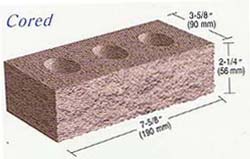
The solid density Ƿs of brick ceramic depends on the clay composition and varies from about 2250 kg m-3 , most commonly lying close to 2600 kg m-3. For an individual brick material, the bulk density Ƿ = Ƿs( 1 - n ) exactly, were n is the porosity. Figure 3 shows the general inverse correlation between bulk density and porosity for a diverse sample of different clay bricks, among which Ƿs also varies. Since varies widely among bricks of different kinds and since frogs and perforations may be present, standard format bricks vary greatly in weight, from about 1.8 kg to about 3.8 kg.
 |
| Figure 2 Suction ( hydraulic potential ) of a clay ceramic ( porosity n = 0.30 ) plotted against water content |
Compressive strength and other mechanical properties
The compressive strength is the only mechanical property used in brick specification; it is the failure stress measured normal to the bed face. Bricks are tested wet, normally with frogs filled with hardened mortar.
A considerable variation is found between individual bricks and a batch of ten is tested to obtain a mean strength. Full details are laid down in BS 3921; the tests prescribed in other national standards differ somewhat. Generally, compressive strength decrease with increasing porosity ( figure 4 ), but strength is also influenced by clay composition and firing. The compressive strength is limited by brittle fracture and is sensitive to individual flaws in the sample under test, including those associated with large particles, fissures formed during shaping, and shrinkage cracks.
The Young's modulus of elasticity of brick ceramic lies usually in the range 5 to 30 kN mm-2.
Brick ceramic itself is not subject to creep at normal temperatures although creep may occur in brickwork.
The flexural strengths of brick materials are sometimes required in calculations of the lateral strength of brickwork. A three-point bending test may be used, for example that described in the RILEM procedure for autoclaved aerated concrete (RILEM, 1994). Brick ceramic is relatively weak in tension and the flexural strength ( or modulus of rupture ) is typically only 5 - 10 % of the compressive strength.
 |
| Figure 3 Volume fraction porosity n plotted against bulk density Ƿ for a sample of 61 clay bricks of several different types ( each type denoted by a different symbol ). |
Efflorescence and soluble salts content
Brickwork ( especially new work ) sometimes develops an efflorescence of white salts brought to the surface by water and deposited by evaporation. These salts may have am external origin ( for example in soil water in contact with the brickwork ) or may derive from the mortar; however the salts frequently originate in the bricks themselves.
As already noted fired brick ceramic may contain soluble salts, in which the sulfates of sodium, pottasium, magnesium and calcium usually predominate. The total soluble salts content of bricks may be as high as 5 % by weight, although it is more commonly 0.1 to 1 %. Visible efflorescence can be formed from very small amounts of salts and the total salt content is not reliable guide to efflorescence liability. This is also affected by the mobility of the salts ( which in turn depends on ceramic composition and the pore structure of the brick ) and is best assessed directly by repeated wetting and drying of test brick.
Efflorescence may be disfiguring but it is often harmless and disappears after a few seasons. However, efflorescent salts usually contain a high proportion of sulfates, and the engineer should be alert to the possibility of sulfate attack on cement mortar joints. This risk is the greater if the situation is exposed and the brickwork is persistently wet.
 |
| Sulfate attack. |
The total sulfate content of the brick is a fair guide to the risk of sulfate attack in mortars with which they are in contact. Accordingly, the soluble salts content is used ( together with frost resistance ) in BS 3921 as a guide to durability. Bricks of designation L ( low soluble salts content ) are not permitted to contain more than 0.50 % by weight of soluble sulfate ion, or more than 0.03 % of each magnesium, potassium or sodium ions. Bricks of designation N ( normal ) may not contain more than 1.6 % of soluble sulfate or more than 0.25 % total magnesium, potassium and sodium ions.
 |
| Figure 4, The correlation of compressive strength and water absorption in seventy commercial bricks. |
Moisture expansion
Fired brick ceramics exhibit a long-term expansion on exposure to moist air. Moisture expansion is progressive and continues indefinitely, although at a diminishing rate, such that the total expansion increases roughly as log(time). Thus flettons fired at 1050 Degree Celsius showed increases in length of 0.02 % at 10 days, 0.04 % at 100 days and 0.06 % at 1000 days. The exact cause of moisture expansion is still unclear, but it apparently involves some degree of irreversible recombination of water with amorphous or glassy constituents of the brick ceramic. The expansion rate depends on the mineralogy of the fired clay and to a marked extent on the porosity and the maximum firing temperature, but it is not greatly influenced by exposure conditions. Bricks made from clays with high lime contents ( notably Gault clays ) generally give low expansions as little glassy material is present in the fired ceramic.
In a study of ten brick clays Smith ( 1973, 1993 ) found moisture expansions after 28 years ranging from 0.20 % to as low as 0.02 %. Long-term ( commonly 50 year ) moisture expansion in service can now be predicted from short-term steam exposure tests. Clay bricks may be assigned to one of three classes according to the estimated 50 year moisture expansion: low ( < 0.04 % ), medium ( 0.04 - 0.08 % ) and high ( > 0.08 % ). It is now recognised that the long-term contribution of moisture expansion to movement in clay brick masonry can be considerable and it is essential to allow for this in design. Reversible changes in dimensions on wetting and drying brick ceramic are less than 0.01 % and are negligible for most purposes.
Frost damage
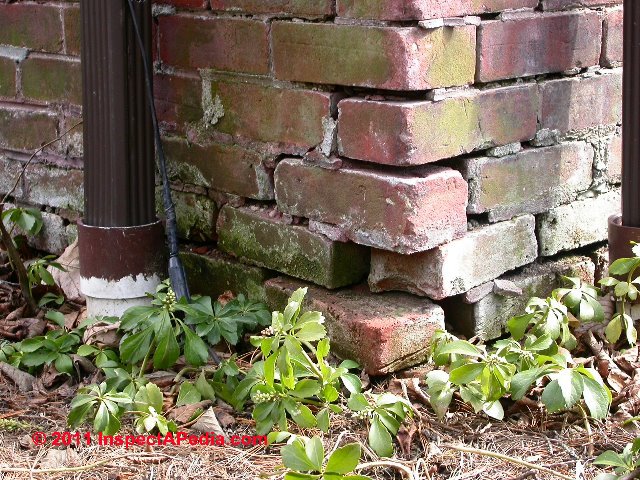
Frost damage is the physical deterioration to which wet bricks may be liable when exposed to freezing conditions. It represents a major cause of failure in certain bricks under conditions of severe exposure and one which should receive full attention at the time of specification and selection.
Frost damage arises from the stresses created within bricks by the freezing of water within the pores, stresses which lead to cracking and splitting, often with spalling of the brick face, either by popping or delamination. The factors which lead to susceptibility to frost damage in particular bricks are not yet well understood. Strong bricks of low porosity are generally resistant to frost damage, but so also are many porous bricks of lower strength. At present no entirely satisfactory laboratory test is available, and liability to frost damage is assessed when required by observation of field performance. Resistance to frost damage is a major criterion of durability and is one of the factors used in the classification of bricks in BS 3921.
 |
| Frost Damage |
Thermal properties
Thermal conductivity of brick ceramic is controlled by the proportions of crystalline and glassy constituents, and the porosity. Dry brick of bulk density 2400 kg m-3
The coefficient of thermal expansion of most clay bricks lies in the range 5 to 7 x 10⁻⁶ K-1.
Resistance to chemical attack
Brick ceramic is generally very resistant to alkalis, acids and most commonly encountered chemicals and is attacked only under extreme conditions. However bricks required to perform under severe acid conditions, for example in chemical plant, and clay pipes for acid effluents, are specially selected.
Behaviour under fire conditions
The coefficient of thermal expansion of most clay bricks lies in the range 5 to 7 x 10⁻⁶ K-1.
Resistance to chemical attack
Brick ceramic is generally very resistant to alkalis, acids and most commonly encountered chemicals and is attacked only under extreme conditions. However bricks required to perform under severe acid conditions, for example in chemical plant, and clay pipes for acid effluents, are specially selected.
 |
| Chemical attack |
Behaviour under fire conditions
Because it is itself a fired material, the performance of brick ceramic under fire conditions is generally excellent. Thermal stresses may produce some spalling in certain types of bricks, and in severe fires, temperatures may approach the vitrification range of brick, causing slight fusion of exposed faces. Neither of these effects seriously diminishes fire resistance. The fire resistance of perforated brick and cellular brick masonry is somewhat lower than that of the same thickness of solid brick, which generally has greater resistance to thermal shock and better resistance to the transmission of heat at high temperatures.
 |
| Insulating fire brick |